Read the land. Trace the journey.
Use a physical map to connect California’s regions with the practical choices people face when traveling.
Open lesson 1 & worksheet ↗One Warm Line · For educators
Fourth-grade lesson plans connecting California history, evidence, and musical storytelling.
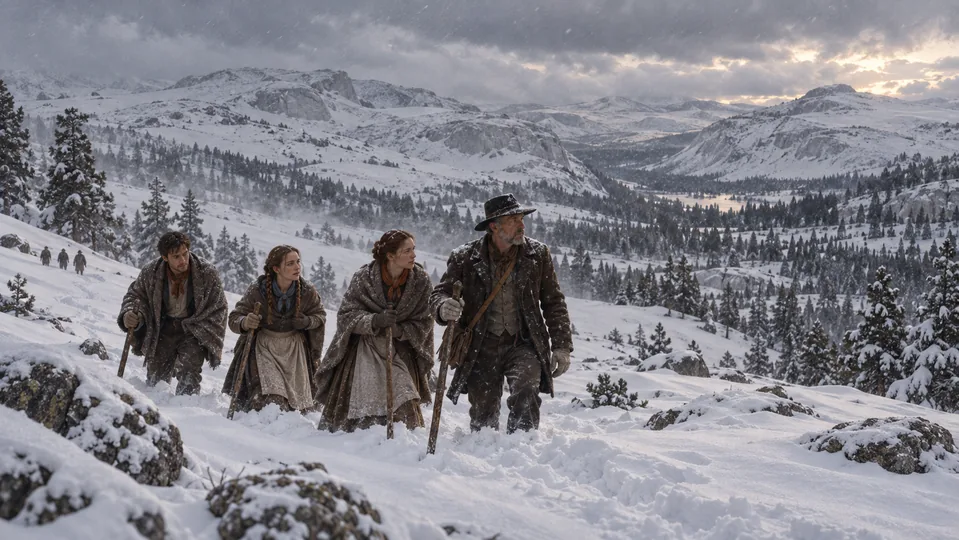
Start with a question
Teach the sequence across four class periods or use a lesson independently. Every plan includes an objective, preparation, timed activities, a student worksheet, access options, and assessment notes. The reading cards make the lessons usable without a full performance or recording.
Use a physical map to connect California’s regions with the practical choices people face when traveling.
Open lesson 1 & worksheet ↗Compare the Donner–Reed journey with later Gold Rush migration, using dates to test a historical claim.
Open lesson 2 & worksheet ↗Bring two readings together to understand the Sierra region as a place of travel and an enduring homeland.
Open lesson 3 & worksheet ↗Explore how music can express a feeling while a source supports a historical claim.
Open lesson 4 & worksheet ↗California curriculum connections
These are Skyrider Storyworlds’ instructional mappings to selected California standards, not state approval or a claim to cover each standard in full. Teachers should place the activities within their existing curriculum.
| Standard | Connection | Evidence in these lessons |
|---|---|---|
| HSS 4.1.3 | California’s capital, regions, and environment’s influence on people. | Lesson 1: labeled map and explanations. |
| HSS 4.3.2 | Compare reasons, modes, and routes of travel to California. | Lesson 2: migration comparison with dated evidence. |
| RI.4.1 | Support explanations and inferences with text details. | Lessons 1, 3, 4: evidence notes. |
| RI.4.3 | Explain historical events and causes using a text. | Lesson 2: chronology and correction of a claim. |
| RI.4.9 | Combine information from two texts on a topic. | Lesson 3: a response joining travel and homeland perspectives. |
| W.4.2 | Develop clear informational explanations with facts and conclusions. | Lessons 2 and 4: explanatory paragraphs. |
| W.4.8 | Paraphrase, organize notes, and list sources. | Lesson 3: evidence organizer and source list. |
Read the official California History–Social Science Content Standards, grade four, printed pages 12–13 and California Common Core ELA Standards, grade-four columns for reading and writing. Descriptions above are paraphrased.
For fourth grade and beyond
Our educational goal is to make One Warm Line a doorway into California history for fourth graders and learners across the state. Start with a question, pair a teacher-selected scene or song with a source, and follow with discussion and student work. Watching alone does not demonstrate a standard.
Teacher viewing note: The Donner–Reed history includes starvation, death, violence, and cannibalism. These lessons use non-graphic summaries focused on geography, evidence, and interpretation. Preview any full production, recording, lyrics, artwork, or external reading before sharing it; select what is suitable for your class and provide an equivalent reading or writing option.
The fourth-grade plans can be adapted for other California classrooms by changing text complexity, source depth, and writing demands. Teachers must select the standards for their own grade. The full stage and television versions remain in development; this resource is not a certification of every version’s age suitability.
Our approach to accuracy
Historical care is a creative priority for One Warm Line. Our educational materials make their sources visible and invite students to ask how a claim is known.
Educators and researchers can send Collin Poseley a source, correction, or classroom suggestion.