Music makes the argument.
A salesman’s refrain can become a crowd’s conviction. A dance can make strangers feel like neighbours. Sung together, competing hopes and fears can occupy the same moment.
SKYRIDER STORYWORLDS / MUSICAL THEATRE
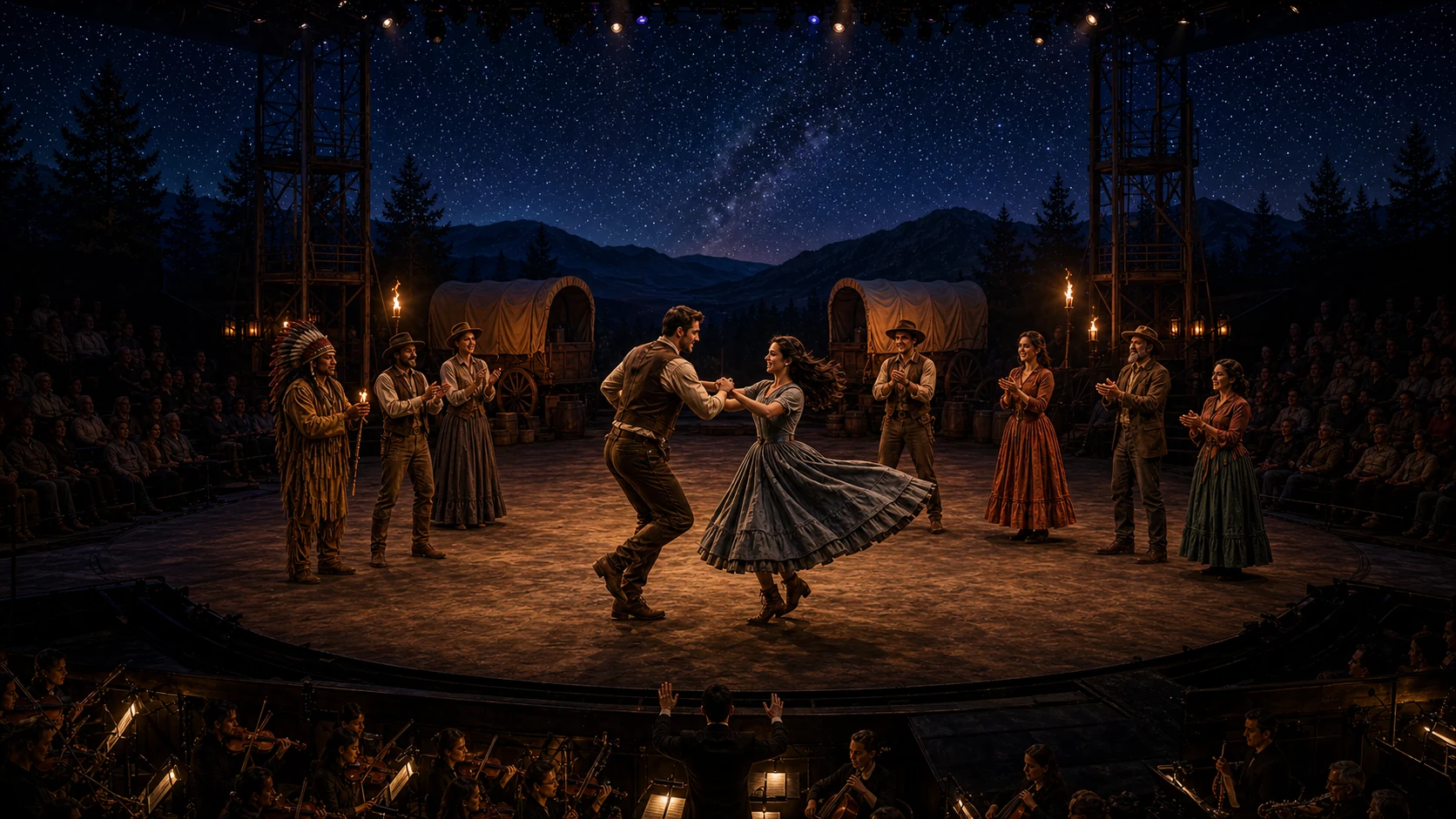
An epic journey. One shared room.
A frontier musical imagined in the round.
A STAGE VISION IN DEVELOPMENT
THE DONNER–REED JOURNEY / 1846
On the road to California, James Reed and his daughter Virginia stake their future on a promised shortcut. When Reed is exiled and winter traps the company, their journey becomes a struggle to find one another—and a reason to keep going.
Read the full synopsis01 / THE VISUAL NOTEBOOK
From the warmth of a shared dance to the silence of the snow. Explore the core staging language and two larger scenic possibilities, with music alongside every image.
Concept artwork, including AI-generated imagery. An exploration of a future production.
THE CORE STAGING LANGUAGE
Intimate performance, visible transformations and a small vocabulary of timber, light and movement connect these six studies.
 Explore concept +
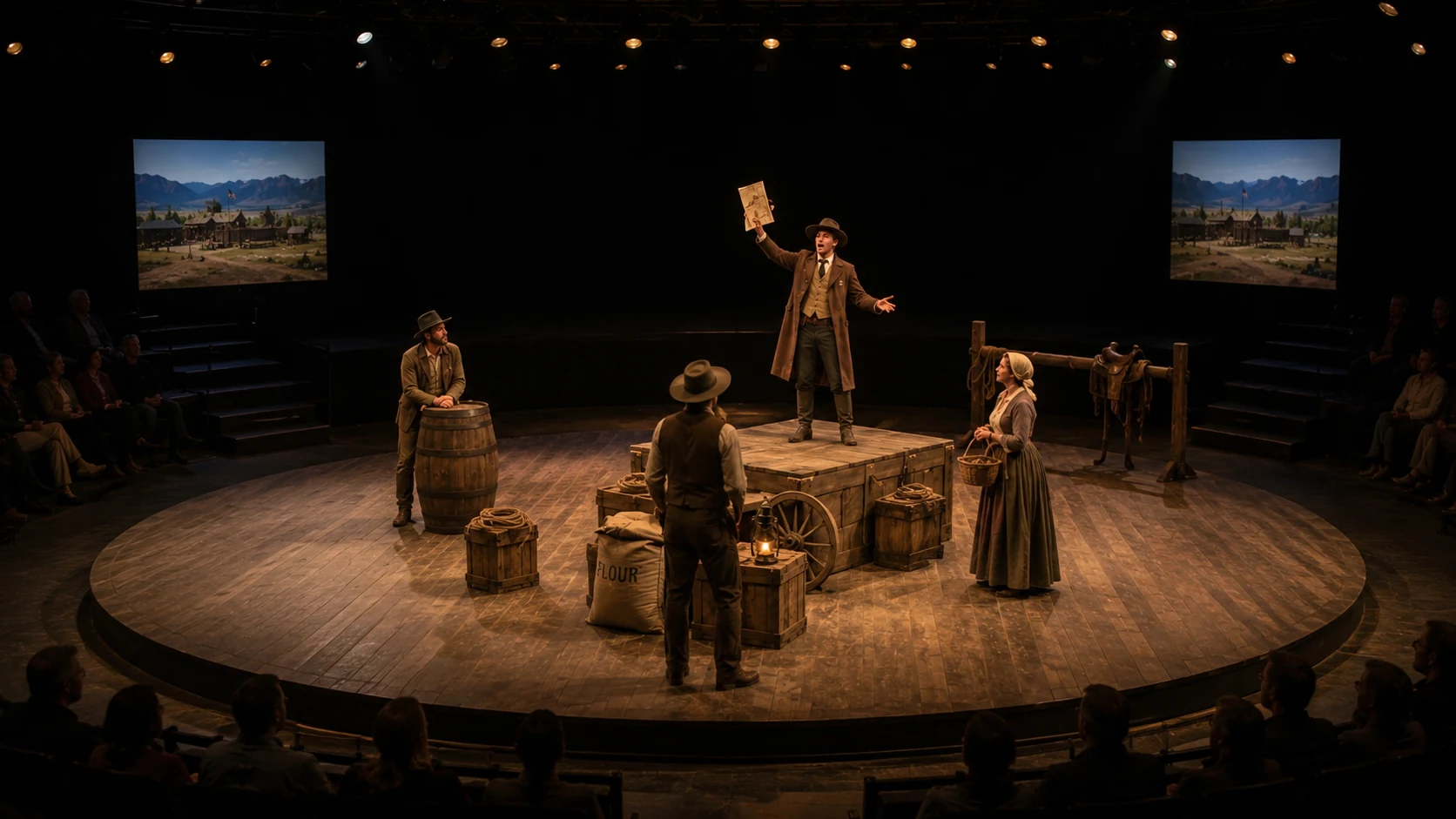
01 The promise
Hastings makes his pitch at the centre of a gathering company. A platform, a few crates and a circle of listeners turn persuasion into public spectacle.
LISTEN TO THE SONGThe Shorter Way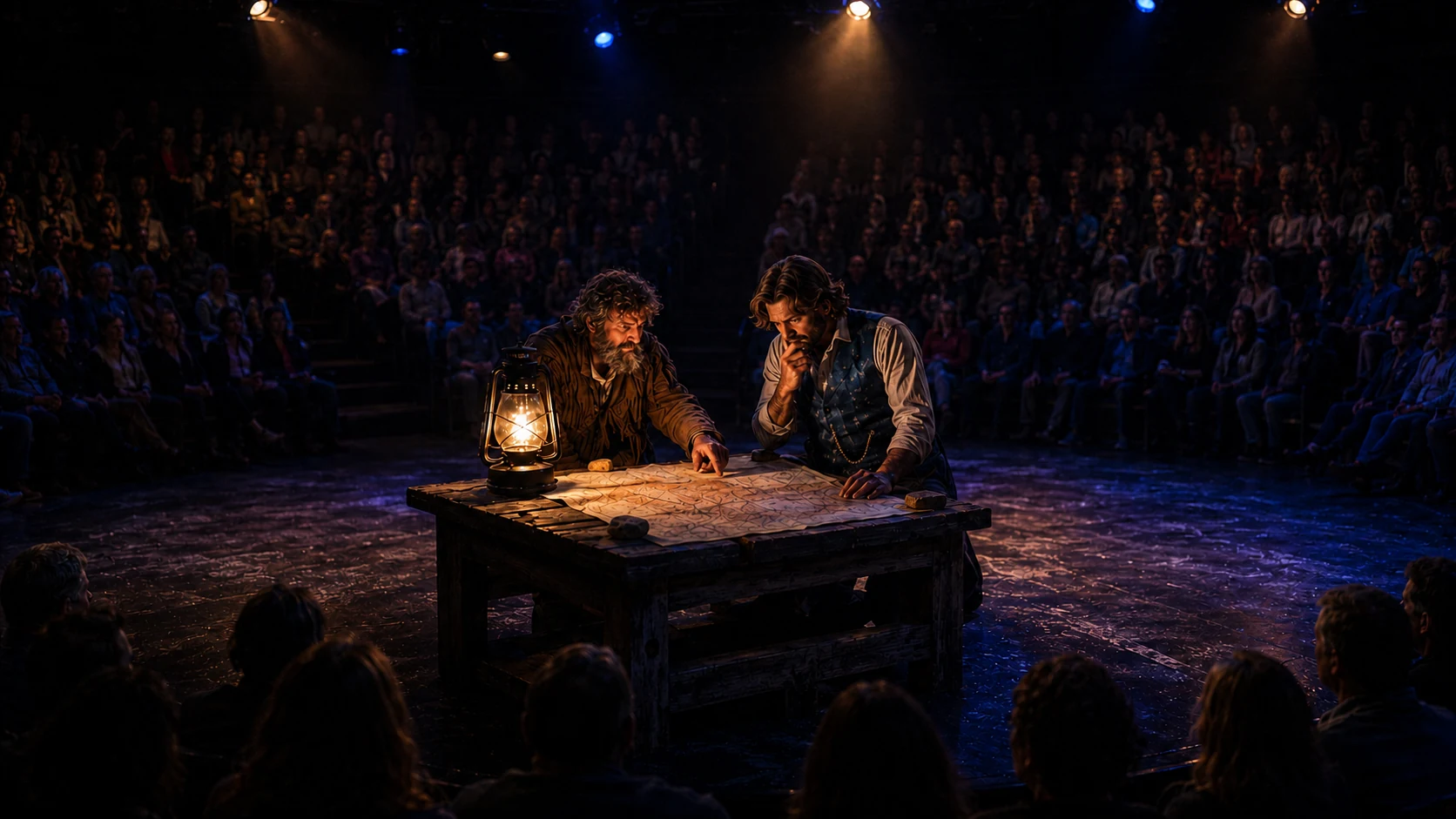 Explore concept +
02 The warning
Two men, a map and a lantern. Clyman and Reed’s confrontation explores how little scenery a decisive argument needs when the audience is close enough to witness it.
LISTEN TO THE SONGClyman’s Warning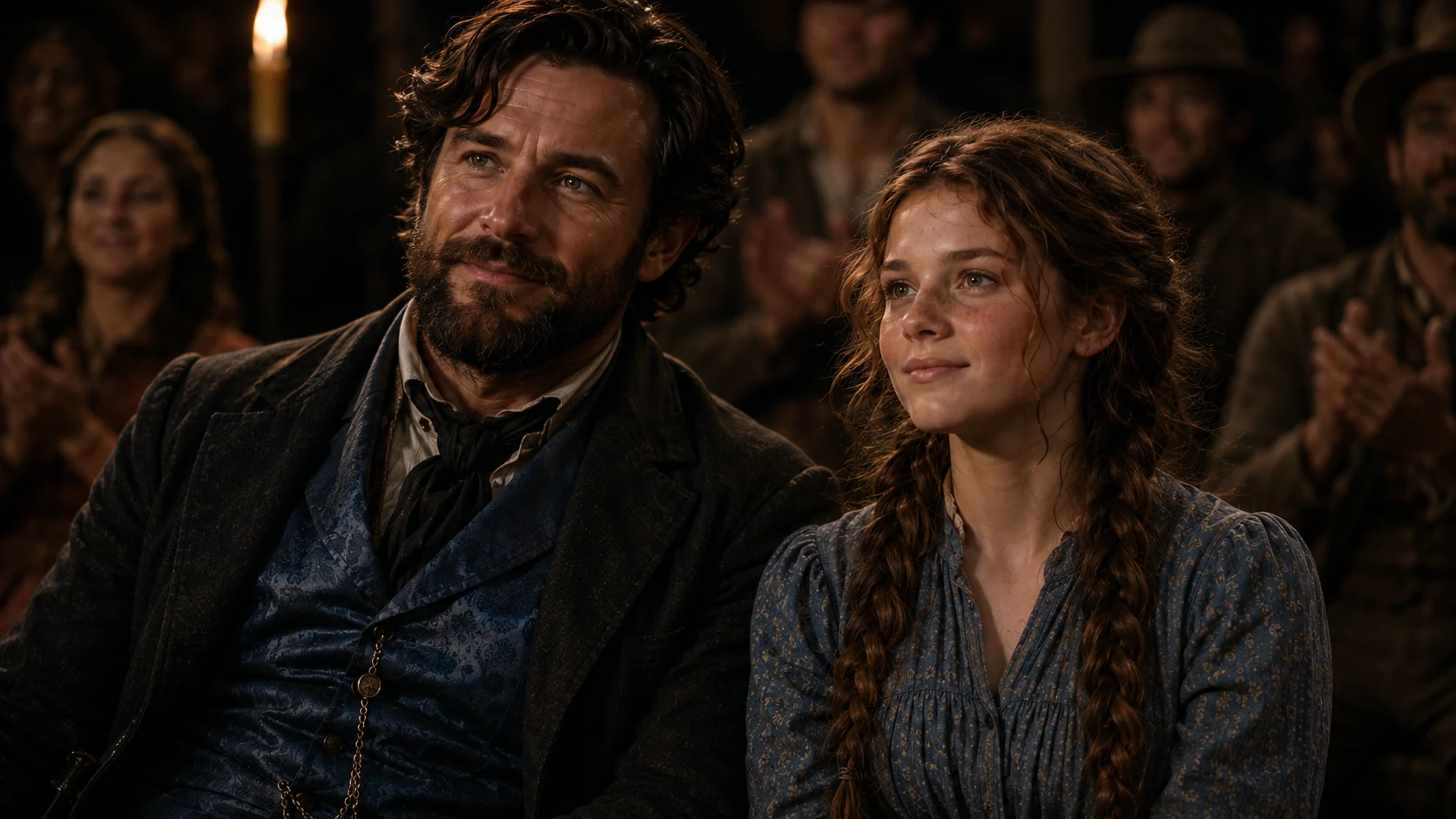 Explore concept +
03 The family within the company
Reed and Virginia share a moment inside the celebration. Close character studies keep the family relationships at the centre of the larger ensemble world.
LISTEN TO THE SONGHey Ho!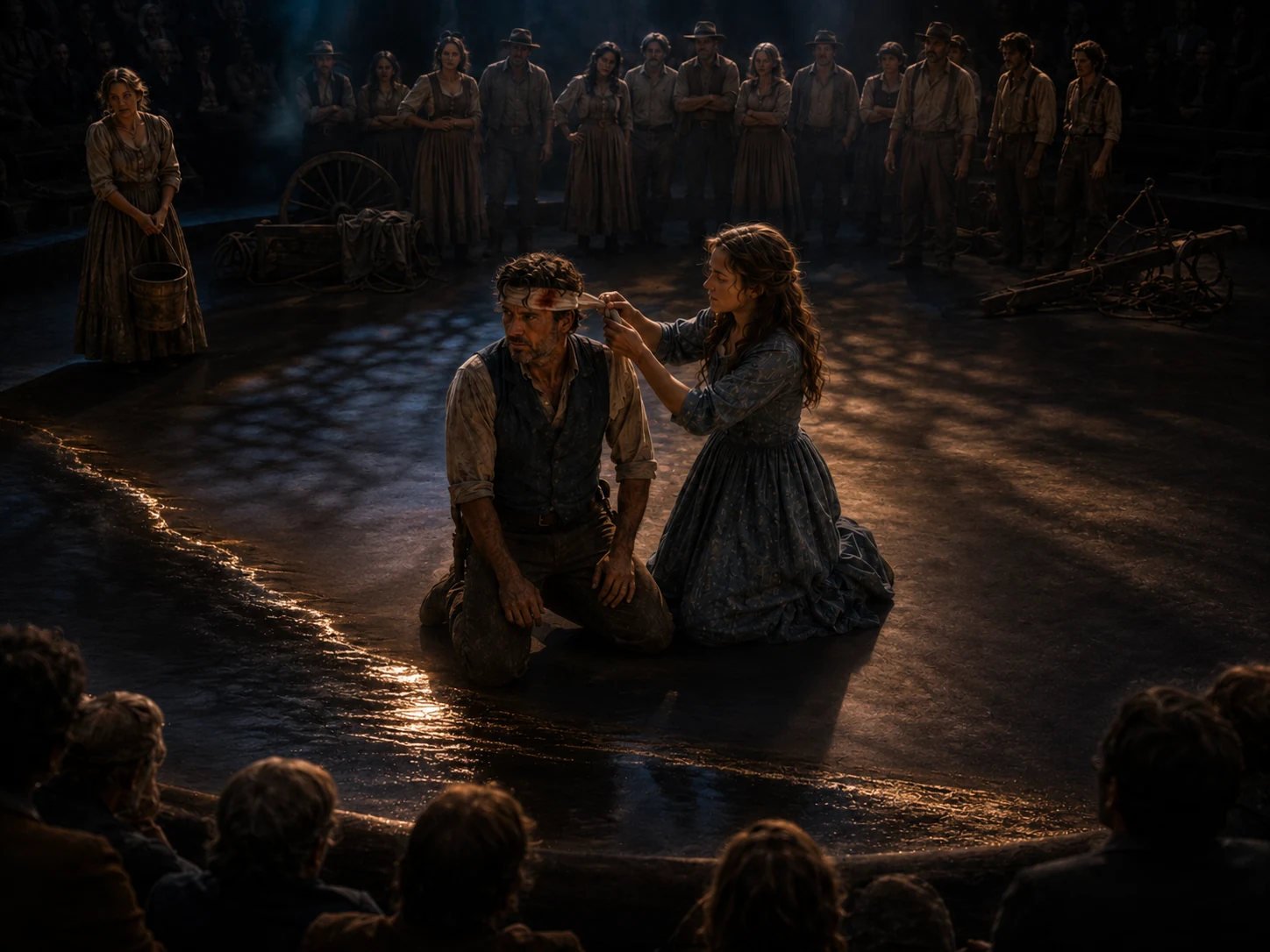 Explore concept +
04 The separation
A father and daughter face the cost of the company’s judgement. The surrounding ensemble gives a private farewell its public pressure.
LISTEN TO THE SONGExiled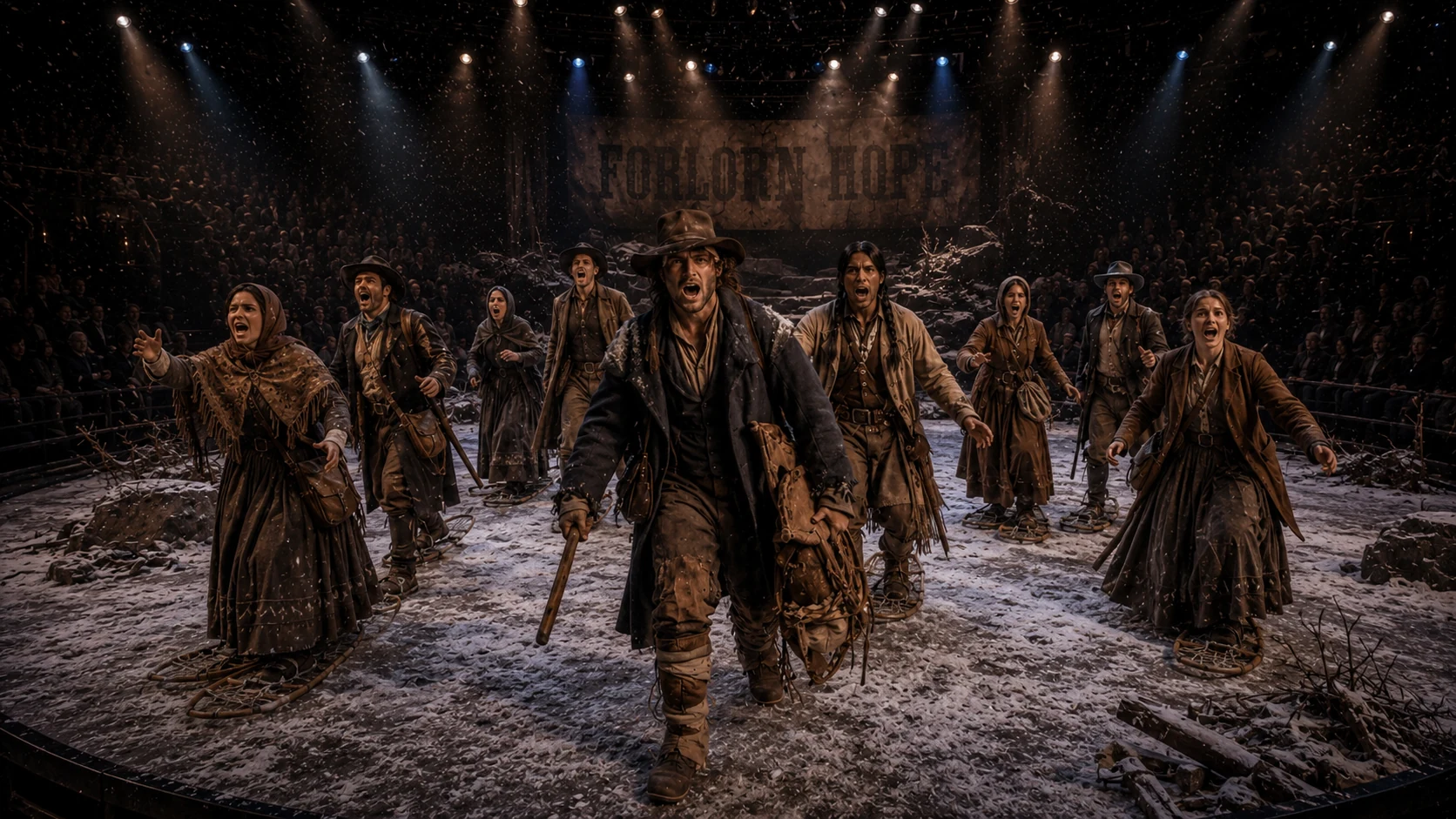 Explore concept +
05 The winter crossing
The company becomes a fragile line in the snow. Cool light, open space and the effort of each body carry the weight of the mountains.
LISTEN TO THE SONGThe Forlorn Hope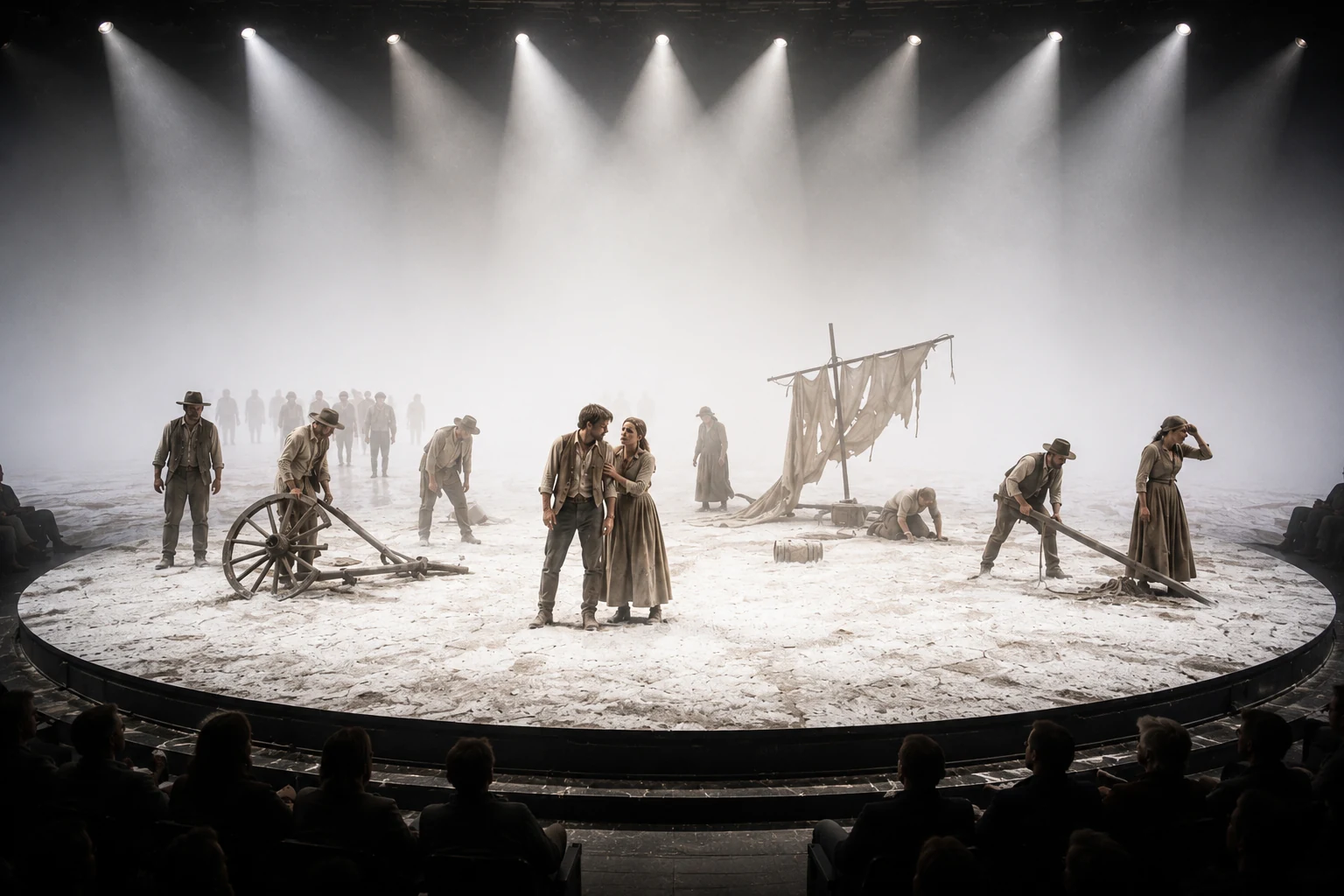 Explore concept +
06 The exposed stage
Bleached light and the remnants of a camp leave the company exposed. This study pares the world back to bodies, distance and what remains after the journey has taken its toll.
LISTEN TO THE SONGOut of ControlLARGER SCENIC EXPLORATIONS
These two studies explore panoramic projection and a fuller scenic world. Their scale remains an open question for development.
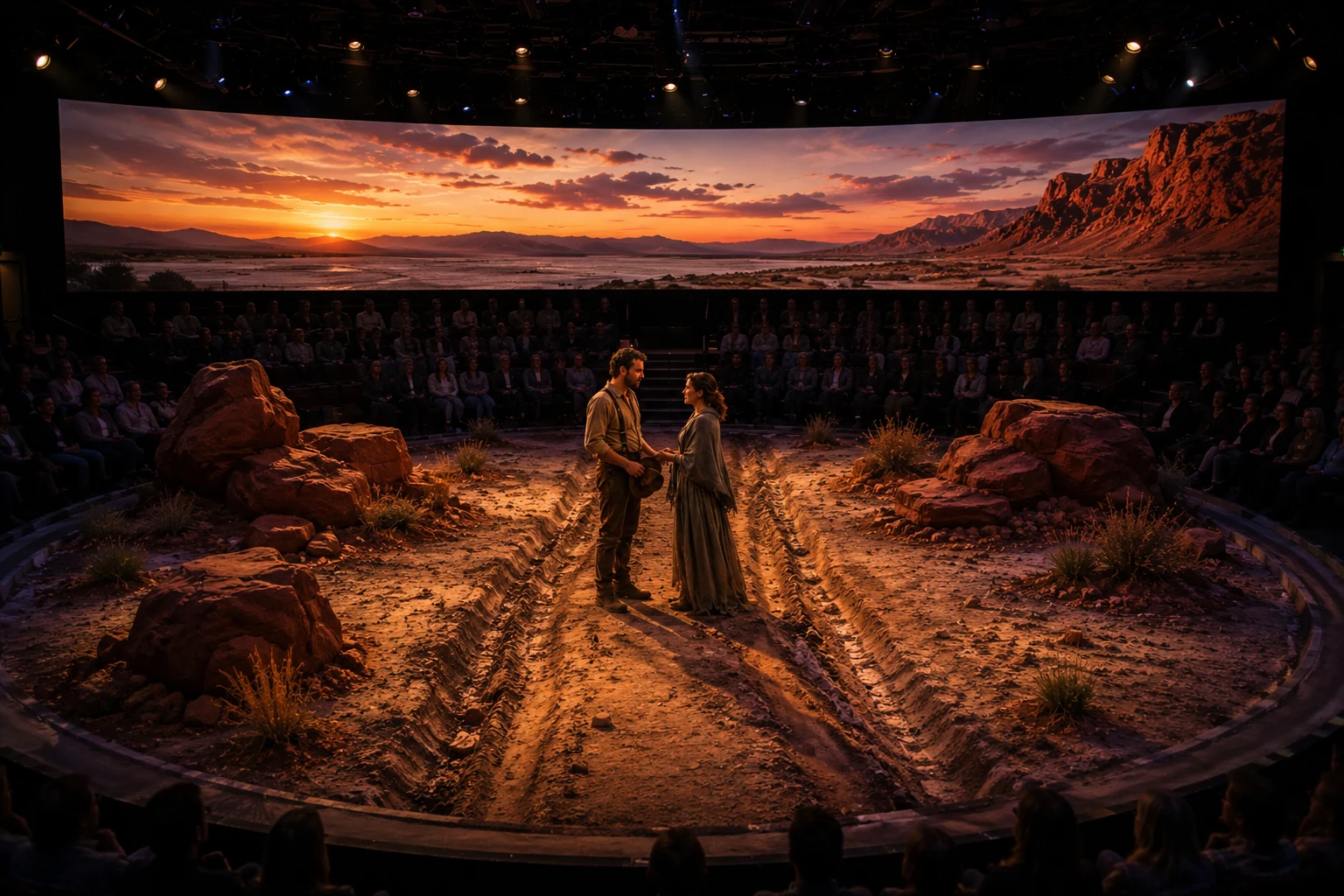 Explore concept +
07 The landscape
A sunset stretches around two figures and a trail of wagon tracks. A projected horizon expands the room while the performers carry the human scale of the crossing.
LISTEN TO THE SONGOver in the Desert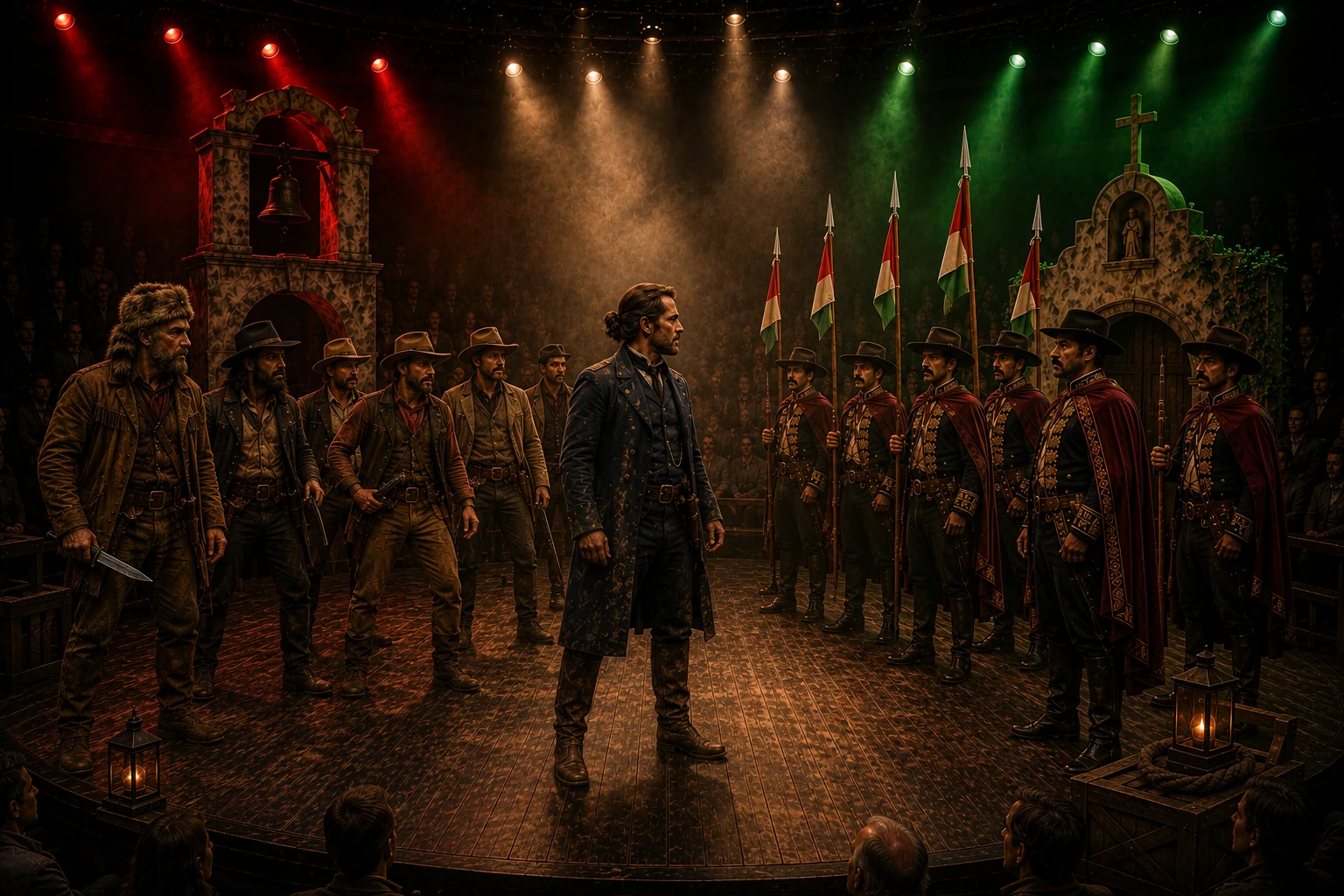 Explore concept +
08 The wider conflict
Flags, lances and opposing washes of colour surround Reed. Choreography and light make the political struggle pressing in on the family story visible.
LISTEN TO THE SONGPloughshares to Rifles02 / SYNOPSIS
In 1846, a company of families stakes its future on the road to California. A promised shortcut puts everything they carry—and everything they believe—at risk.
One Warm Line follows James Reed, his daughter Virginia, and the families travelling alongside them. At Fort Bridger, Lansford Hastings sells “The Shorter Way”—and the promise that ambition can outrun winter.
Celebration gives way to exhaustion as the trail tests marriages, friendships and loyalties. A fatal confrontation leaves Reed exiled from the company. While he struggles to find a way back to his family, those still on the trail face a closing mountain pass and the terrible uncertainty of a winter without enough food.
A snowshoe party—the Forlorn Hope—sets out to seek help. Rescue brings reunion, but it cannot undo every loss. The survivors must discover how to keep living with the people and memories they carry.
A synopsis of the developing musical-theatre adaptation. The story draws on the Donner–Reed journey; scenes, characters and songs form a dramatic interpretation.
03 / WHY THE STAGE
The heart of OWL is the relationship between people under pressure. Live theatre gives those relationships a physical presence: a hand offered, a place withheld, a voice answered by another.
A salesman’s refrain can become a crowd’s conviction. A dance can make strangers feel like neighbours. Sung together, competing hopes and fears can occupy the same moment.
The mountains may be immense, but the action is close: a parent counting children, two travellers sharing warmth, a company deciding whom to trust. The audience can follow the cost of a choice in the body of the person making it.
Carrying, waiting, returning: these are theatrical actions as well as the story’s moral centre. An ensemble can make dependence on one another visible with every crossing of the space.
04 / THE STAGING IDEA
Our current exploration centres on theatre in the round: the company inside a circle of witnesses.
A shared timber floor becomes a trading post, a dance, a gathering of wagons or a snowbound camp. Crates, trunks, wheels and simple platforms provide a practical vocabulary that performers can rearrange in view.
Light, sound and projected horizons suggest distance and changing weather. The landscape can expand around a quiet duet, then contract to the small circle of warmth that remains in winter.
Movement carries the journey. Circular dances become crossings; a crowd opens into rival groups; a line of travellers thins against the snow. The intention is to let the same space accumulate the memory of what happened there.
These are design explorations. The playing configuration, technical approach and production scale remain open to development.
CONTINUE INTO OWL
We’re seeking theatre collaborators to explore a developmental reading or workshop of OWL. We’d love to hear from directors, music directors, and producing or venue partners interested in helping shape that next step.
The aim: hear the score with performers, test the ensemble storytelling, and discover what the piece needs in a shared room.
One Warm Line · Collin Poseley & Nick Almond
A Skyrider Storyworlds project